Building a society that operates with a deep understanding of Neurodiversity allows all of us to flourish. Neurodiverse accessibility is not just about adapting physical spaces, but also adapting approaches, social norms, and communication methods, so that people with different neurological profiles, especially autistic adults, can participate fully and authentically in society. This involves a conceptual shift that recognizes diversity as a strength, and that challenges lie not within the individual but in an environment that is not adapted to their unique needs.
In this article, we will examine the guiding principles for creating inclusive spaces, addressing the various aspects of the neurodiverse experience. The focus will be on autistic adults, who often experience adaptation challenges for many years and learn complex Masking techniques to meet social expectations. Accessibility for autistic people is key to breaking cycles of Autistic Burnout and loneliness, and to building fulfilling and meaningful lives. We aim to enable every person to feel a sense of belonging and security, while promoting their overall well-being.
Understanding the Neurodiverse Experience: Beyond Stereotypes
To create true neurodiverse accessibility, we must understand the world from the perspective of people on the Autistic Spectrum. Many autistic people describe how they experience the world intensely and richly, but also differently from most of the population. This manifests in differences in information processing, sensory experience, social interaction, and communication. For many years, the prevailing understanding of Autism was based on outdated stereotypes and a deficit-focused model, which led to ignoring the rich inner experiences of autistic people.
One of the key aspects affecting autistic adults is the need for social Masking. Masking is the conscious or unconscious effort to suppress or hide autistic traits and adapt behaviors to Neurotypical norms. Many people have learned to 'be chameleons' - changing their personality and behavior according to the environment and the expectations of those around them. This process requires enormous energy resources and can lead to Autistic Burnout, anxiety, and a sense of self-loss. In an inclusive environment, the need for Masking decreases, allowing people to be authentic and channel their energy into more constructive things.
Sensory differences are also a major factor in the autistic experience. People on the Autistic Spectrum may experience sensory stimuli - such as bright lights, sudden noises, strong smells, or touch - with significantly higher or lower intensity than average. Hyper Sensitivity can lead to rapid Sensory Overload, while Hyposensitivity may create a need for additional stimuli (for example, through Stimming). An environment that does not take these differences into account can be exhausting, painful, or confusing, and prevent active participation.
The need for structure, routine, and predictability is another prominent characteristic. People on the Autistic Spectrum often describe the difficulty of adapting to unexpected changes, even if they seem small. A simple change in the arrangement of items in a supermarket or a disruption in a schedule can cause significant cognitive overload. The ability to anticipate what will happen, to know what to expect, and to receive advance notice of changes, provides a sense of security and reduces anxiety. Therefore, inclusive spaces should strive to provide consistency and offer clear and accessible information about any expected changes.
Communication Impacts: Beyond Words
Communication is a cornerstone of human interaction, and among people on the Autistic Spectrum, it can manifest in diverse forms. Many autistic people describe difficulty understanding non-verbal social cues, interpreting sarcasm or irony, and engaging in small talk that is not goal-oriented. There is also difficulty understanding unwritten social codes that most people learn intuitively. On the other hand, autistic people often tend towards direct, honest, and often very detailed communication, out of a desire to prevent misunderstandings. Accessibility for autistic people requires recognition of different communication styles.
The phenomenon of 'over-explaining' is very common among people on the Autistic Spectrum. The urge to explain things in great detail often stems from past experiences where misunderstandings led to conflicts or frustration. People believe that by providing more information, they will clarify their intentions and prevent misinterpretations, but in practice, this can lead to information overload for the other party. For this reason, inclusive spaces should encourage clear and concise communication, with the option to expand and elaborate when needed, while also developing patience and understanding towards different communication styles.
Principles for Truly Inclusive Space Design
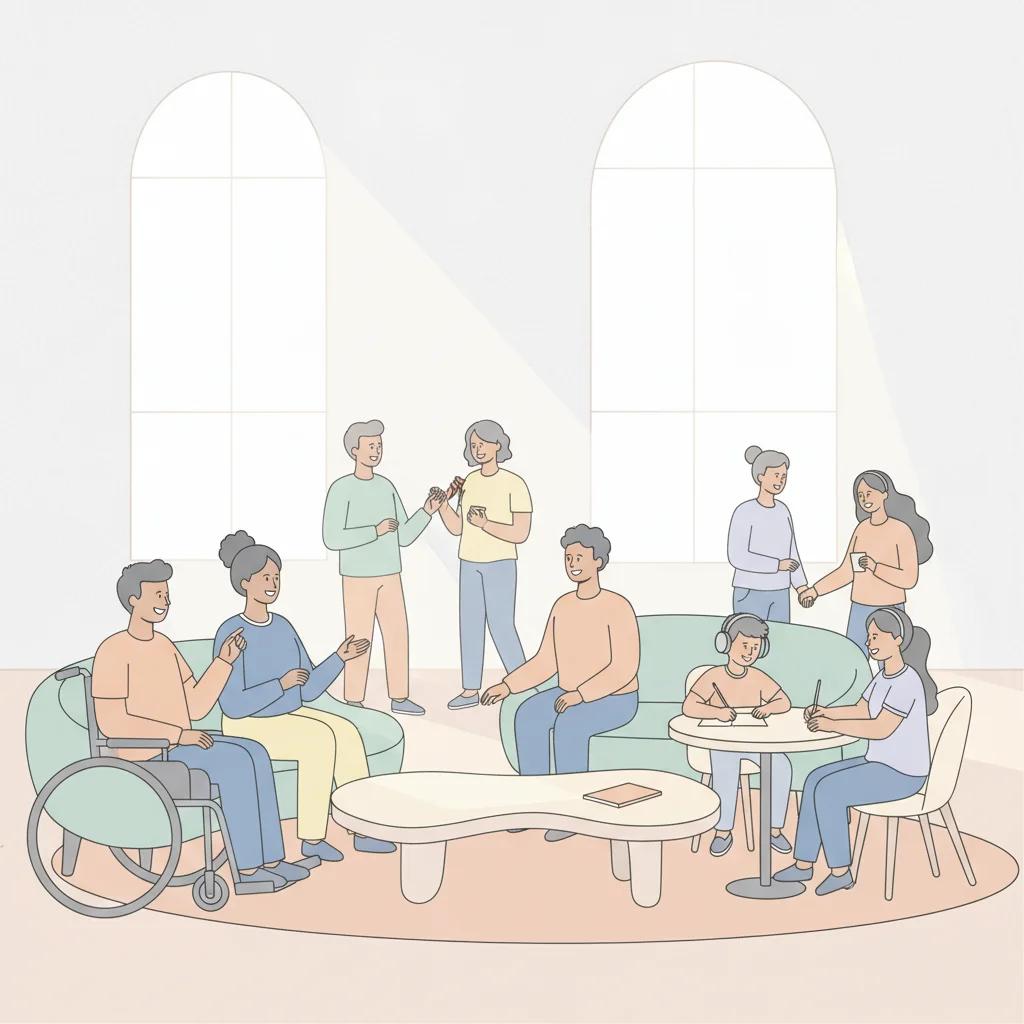
Creating neurodiverse accessible spaces requires a multi-dimensional approach that addresses physical, social, and communicative aspects. The goal is to reduce barriers, increase the sense of security, and enable maximum participation for every person. When we design spaces with neurodiverse needs in mind, we are actually improving the environment for everyone, as these principles contribute to creating a calmer, clearer, and more pleasant environment.
Environmental and Physical Adaptations
Adapting the physical environment is a first and critical step. Attention should be paid to potential sensory stimulus sources and an attempt should be made to minimize their impact. For example, in lighting, bright or flickering fluorescent lights can cause headaches and Sensory Overload. The preference is for soft, as natural as possible lighting, or the ability to control the intensity of the lighting. Noise is another factor: open and noisy spaces make concentration difficult and contribute to Autistic Burnout. Acoustic materials can be used, dedicated quiet areas can be created, or the use of noise-canceling headphones can be encouraged.
Smells are also a significant factor. Strong smells from perfumes, cleaning products, or food can be overwhelming. A scent-free space or one with subtle and natural scents is preferable. In addition, materials and touch can have an impact. Comfortable furniture, pleasant-to-touch fabrics, and diverse seating options can contribute to a sense of comfort. Allowing people to move freely, to use Stimming for self-regulation, and even to take planned breaks, is crucial for energy management and personal well-being. Accessibility for autistic people touches every detail of the physical environment.
Support for Communication and Social Interaction
Inclusive spaces should promote clear, direct, and accessible communication. This means avoiding ambiguous phrasing, sarcasm, or subtle hints that may not be understood. Written communication with clear and detailed instructions can be helpful, especially when conveying important information. Asking questions should be encouraged, and it should be made clear that there are no 'stupid questions,' and that the purpose of the conversation is mutual understanding. Providing training to staff and the general public on neurodiverse communication styles greatly contributes to reducing misunderstandings and tensions.
In creating social interactions, it is important to understand that not every person desires or is able to form connections in the same way. Providing flexible social engagement options, which also include options for solitary rest, is critical. In social gatherings, 'quiet zones' or 'calm corners' can be created where people can disconnect from sensory overload. Encouraging conversations around Special Interests, instead of small talk, can facilitate the building of meaningful connections. Active listening and respect for communication diversity are essential components.
Neurodiverse Accessibility in Workplaces
The world of work presents a complex challenge for many autistic adults, but it also holds immense potential for integration and growth. Workplaces that adopt a neurodiverse approach benefit not only from a more diverse and inclusive workforce but also from unique qualities such as attention to detail, pattern recognition abilities, loyalty, and expertise in specific Special Interests. Accessibility for autistic people in the workplace is not a perk, but a smart investment in human capital.
Challenges and Solutions in the Work Environment
Workplace challenges are often related to communication, the physical environment, and unstated social expectations. Flexible schedules can significantly help autistic employees manage their energy levels and prevent Autistic Burnout. Similarly, providing options to work in quiet areas or use tools to filter noise and light (such as noise-canceling headphones or window shades) can improve concentration and productivity. Every employee has different sensory needs, and providing personalized adaptation options is key.
Clear and direct communication is critical in the workplace. Managers and colleagues should be aware that different communication styles exist and avoid using vague language, irony, or unstated expectations. Providing written, detailed instructions and avoiding simultaneous task overload can prevent misunderstandings and improve work performance. A work environment that encourages transparency, where employees are free to ask questions and express needs, builds trust and reduces anxiety. It should be recognized that many mistakes stem from misunderstanding rather than lack of ability or willingness.
Promoting an Inclusive Organizational Culture
Beyond physical and communication adaptations, it is important to foster an organizational culture that accepts and values Neurodiversity. Training for all employees, including management, on Autism and other neurodiversities can increase awareness, reduce stigma, and encourage empathy. The unique strengths of autistic people should be highlighted and opportunities provided to leverage them. Many autistic people excel in focused Special Interests, pattern recognition, and attention to detail - traits that are a significant advantage in a variety of roles.
Building support networks within the organization, or connecting to external associations and organizations, can provide autistic employees with a sense of belonging and community. The understanding that you are not alone, and that others share similar experiences, is immensely valuable. Many adults who discovered they are autistic later in life describe how life-changing this discovery was, and the importance of finding a supportive community. An organizational culture that allows people to bring their authentic selves to work, without the need for constant Masking, contributes to personal well-being and professional growth.
Reducing Autistic Burnout and Promoting Personal Well-being
Autistic Burnout is a state of severe physical, emotional, and mental exhaustion resulting from a continuous burden of coping with an unadapted environment, social Masking, and a constant attempt to conform to neurotypical norms. Reducing this Autistic Burnout is a central goal in promoting neurodiverse accessibility, as it directly affects quality of life and the ability to function. Many describe experiencing periods of intense activity followed by periods of complete lack of energy, which makes it difficult to maintain a consistent routine.
Energy Management and Load Reduction
Awareness of personal energy levels and proactive management are critical. This includes understanding what drains energy (e.g., noisy environments, prolonged social interactions) and what recharges it (e.g., alone time, engaging in Special Interests, Stimming). It is important to plan regular breaks, allow recovery time after social events or intense work, and learn to say 'no' when resources are limited. Prioritizing rest and solitude is not a sign of weakness, but an essential strategy for maintaining well-being.
Creating personalized home and out-of-home environments is another significant step. This can include designing a quiet and calm room, using sensory regulation aids (such as weighted blankets, noise-canceling headphones), and creating relaxation corners. The goal is to ensure that every person has a safe and accessible place where they can relax and be themselves without fear of judgment or the need for Masking. Accessibility for autistic people is not just about the outside world, but also about the ability to create a personal sanctuary within the home.
Connecting to Community and Developing Authentic Relationships
Despite the need for alone time, social connections are essential for human well-being. For autistic people, finding a community of people who share similar experiences can be life-changing. These communities provide a place where there is no need to constantly explain yourself, where unique communication styles are accepted with understanding, and where support and identification can be found. Social events specifically designed for neurodiverse people tend to be less exhausting, as they alleviate the pressure to conform to unnatural norms.
Learning and developing self-awareness is also a critical component. Understanding your emotions, the physical signs of overload or Autistic Burnout, and what triggers them, allows you to manage yourself more effectively. This knowledge enables autistic people to communicate their needs more clearly to others, thereby creating a more supportive and inclusive environment. Ultimately, neurodiverse accessibility is an ongoing journey of learning, adaptation, and growth, for a society that values and includes all forms of human existence.
Frequently Asked Questions
What is neurodiverse accessibility?
Neurodiverse accessibility is a holistic approach to creating physical, social, and communicative environments adapted to the needs of people with different neurological profiles, such as autistic people, recognizing neurological diversity as a natural part of human diversity. It aims to reduce barriers and enable full participation.
Why is social Masking harmful to autistic people?
Social Masking is a constant effort to conform behaviors to social norms, and it requires immense energy resources. This process can lead to Autistic Burnout, Sensory Overload, anxiety, depression, and a sense of self-loss, preventing people from being authentic and realizing their potential.
How can the physical environment's accessibility be improved for autistic people?
This can be improved by minimizing sensory stimuli such as strong or flickering lighting, loud noises, and strong odors. It is recommended to create quiet areas, use acoustic materials, and provide options for environmental control, as well as allowing movement and Stimming.
What communication principles are important in inclusive spaces?
Communication should be clear, direct, and free of ambiguity, cynicism, or subtle hints. Transparency, providing written instructions, and patience with different communication styles should be encouraged, with the understanding that preventing misunderstandings is especially important.
How does accessibility for autistic people contribute to the workplace?
It allows for maximum utilization of unique strengths such as attention to detail, pattern recognition abilities, and expertise in Special Interests. This leads to a more diverse, productive, and satisfied workforce, while reducing burnout and improving employee well-being.
What is the key to effective energy management for people on the Autistic Spectrum?
The key is self-awareness of what drains and what recharges energy. This includes planning breaks in advance, allocating time for recovery after intense events, learning to say 'no' when necessary, and creating personalized environments at home and outside.