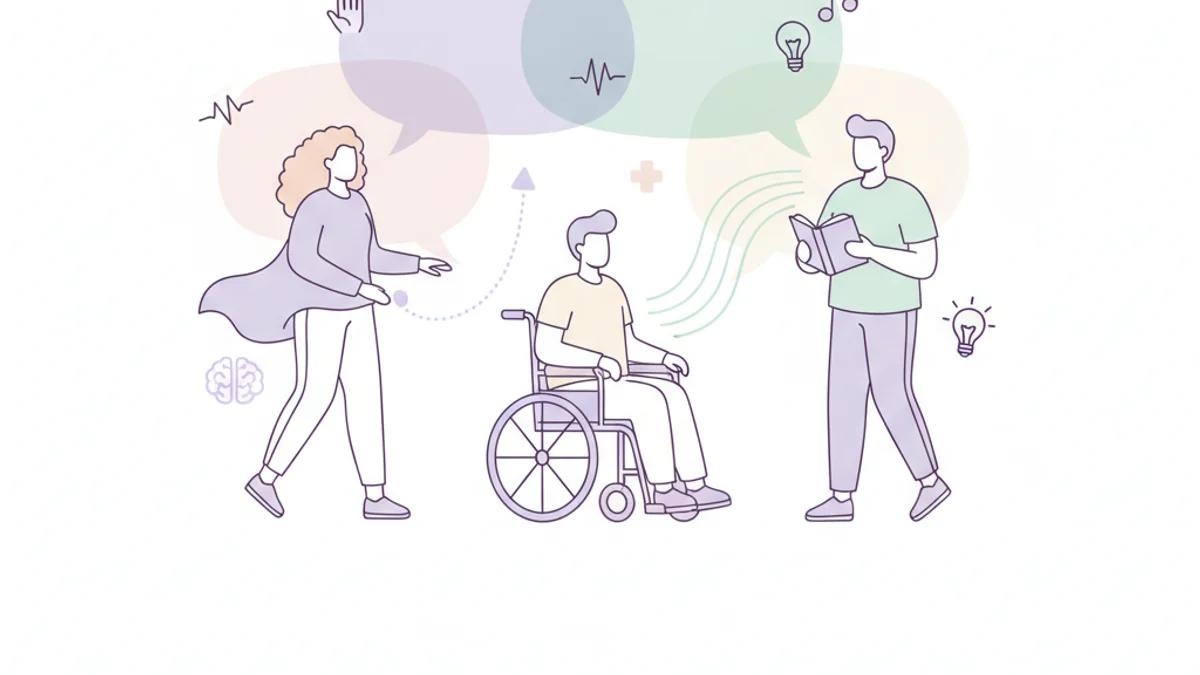
The Autistic Spectrum, sometimes referred to as ADOS, manifests in a wide range of communication and social interaction patterns. It is important to understand that this is an innate neurological difference, which affects how the brain processes information and communicates with the world. It is not a condition to be “cured” or “fixed,” but rather a unique neurological profile that presents its own strengths and challenges. A deep understanding of these patterns allows us to create inclusive and supportive environments, enabling autistic people to thrive.
Within the neurodiversity paradigm, we view Autism as a natural part of the spectrum of human development. Autistic people experience the world differently, and this includes their ways of communication and interaction. This approach emphasizes the importance of recognizing the unique talents and alternative ways in which these individuals communicate and form social connections. This article will focus on these aspects, with an emphasis on the experiences of autistic adults.
Understanding Unique Communication Patterns in the Autistic Spectrum
The communication patterns of autistic people often differ from those of neurotypical people. While neurotypical people rely heavily on non-verbal social cues, such as facial expressions, tone of voice, and eye contact, autistic people may process this information differently or not notice it at all. These differences do not indicate an inability to communicate, but rather a need for more adapted and clearer communication approaches. Communication can be exhausting for autistic people, especially if it requires them to decipher many cues simultaneously.
One of the key aspects is the difficulty in what is called “affective empathy,” which can manifest in social interactions that appear unnatural or awkward. This is not due to a lack of interest in others, but rather a different neurological profile that does not always align with accepted social expectations. Many autistic people describe difficulty understanding unwritten social norms, which often leads to a feeling of alienation or mismatch in a neurotypical environment. This feeling of “difference” accompanies many of them throughout their lives, even from childhood.
Direct and honest communication is often a prominent characteristic of autistic people. They tend to speak their minds without “social games” or indirect hints, which can be a strength in certain relationships. However, in a society that values nuances and indirect cues, this approach can be mistakenly interpreted as insensitivity or a lack of social understanding. For many, the need to explain every single detail to prevent misunderstandings is palpable, but often, the abundance of details can actually lead to further confusion.
Neurological Diversity as a Basis for Communication
The Autistic Spectrum is often described as a different operating system for the brain, similar to comparing different computer operating systems. An autistic brain is not “broken” or “defective,” but simply “wired” differently, leading to diverse ways of processing information. These differences affect all aspects of life, including how a person perceives sensory stimuli, thinks, and responds. For this reason, what appears to be a “problem” in communication for others is actually a natural way for the autistic person to exist in the world.
For example, Hyper Sensitivity or Hyposensitivity significantly affect the ability to interact. Loud noise, dazzling lights, or unexpected touch can be overwhelming and cause distress, making it difficult to participate in regular social events. When a person struggles with Sensory Overload, their ability to focus on communication and social cues dramatically decreases. Therefore, creating quiet and sensory-adapted environments is crucial for effective communication.
The ability to identify patterns and connect different pieces of information is a prominent strength in many autistic people. They may see connections that others miss, and develop deep expertise in Special Interests. These Special Interests can serve as a bridge for communication and connection, when the conversation focuses on topics in which the person is knowledgeable and feels confident. Instead of focusing on “lack,” it is important to recognize “difference” as the basis for unique and valuable communication styles.
Masking and its Impact on Interaction
Many autistic adults have developed Masking and social Camouflaging mechanisms throughout their lives. These are strategies where a person changes their behavior, speech, and expressions to better fit into a neurotypical environment. Masking can include imitating facial expressions, maintaining excessive eye contact, or adopting social scripts that are not natural. Many autistic women, for example, describe how they learned to hide their autistic traits for decades, to the point where even they themselves did not understand it. The Masking process is often unconscious, and it develops in response to social expectations and the desire to avoid rejection or standing out.
There are subtle Masking strategies, designed to make a person blend in with the environment and be socially “invisible.” These strategies include avoiding drawing attention, conforming to the general behavior of the group, and blurring unique characteristics. On the other hand, there are overt Masking strategies, where the person skillfully directs the attention of others to certain aspects of their behavior, thereby hiding what they do not want to be noticed. In both cases, Masking requires immense cognitive and emotional effort, and often leads to deep exhaustion, known as Autistic Burnout.
The constant need to “play a role” can lead to autistic people struggling to know who they truly are beneath the mask. They may lose touch with their authentic preferences, desires, and personality, as they have become accustomed to adapting themselves to the environment. This situation, sometimes described as the “chameleon effect,” causes self-identity to become dependent on the expectations of others. Many years of Masking can make the process of later self-discovery difficult, leaving the person wondering about the essence of their being without an external “filter.” Finding the true “self” requires inner work and a lot of self-forgiveness along the way.
Opportunities for Authenticity and Deep Connection
The process of Unmasking is a personal journey towards self-acceptance and authenticity. When autistic people allow themselves to be who they truly are, without the need to fake social interactions, they open the door to deeper and more genuine connections. Instead of expending energy trying to conform to neurotypical norms, they can direct their emotional and cognitive resources towards building relationships based on mutual understanding and respect for differences. Many autistic people describe how finding a supportive community of like-minded individuals was a life-changing experience, allowing them for the first time to feel a sense of belonging and appreciation for who they are.
In autistic social spaces, there is a tendency to skip superficial “small talk” and move directly to “deep waters”- more meaningful and intimate conversations. These spaces allow autistic people to connect with each other through shared interests and deep passions, rather than through conventional social expectations. This experience can be liberating and nourishing, as it reduces the pressure of adhering to social “scripts.” Meeting other autistic people, who understand each other's unique way of communicating, allows for the creation of genuine connections and eliminates the need for constant Masking. In this way, one can experience connection without judgment, based on mutual acceptance and appreciation.
Challenges and Opportunities in Interactions
Communication between autistic people and neurotypical people can encounter challenges, even with good intentions from both sides. Misunderstandings often arise from differences in communication styles, where one person expects non-verbal cues and the other tends towards more direct communication. Many autistic people describe that they tend to “over-explain” in an effort to prevent misunderstandings, but often this effort actually leads to further confusion or a feeling of impatience on the part of the listener. The intention is good- to clarify, but the result does not always align with the expectation. It is important to recognize that too much information can be as exhausting as too little information.
Difficulties in deciphering unwritten social expectations can lead to unintentional mistakes or violations of social norms. When a person is unaware of certain rules of conduct, they may act in a way that is perceived as inappropriate or insensitive, even though their intention was always good. For example, a lack of immediate response to messages or forgetting to say hello/goodbye can be mistakenly interpreted as a lack of interest or indifference, while they often stem from a different way of processing information or different priorities. Understanding the “why” behind the behavior can make a huge difference in creating communication bridges.
However, the way to deal with these challenges lies in mutual recognition of differences. When both sides are willing to learn and adapt, strong communication bridges can be built. Many autistic people show an exceptional ability to focus on details, solve problems creatively, and think outside the box. These qualities, combined with honesty and directness in communication, can lead to deep and authentic connections in relationships, both personal and professional. In fact, instead of trying to adapt the autistic person to the norm, we can strive to create a broader norm that encompasses a variety of communication styles.
Fostering Meaningful Connections
Building and maintaining meaningful friendships is often a challenge for autistic people, but it is definitely possible and extremely rewarding. One of the keys to these relationships is finding common ground and mutual interests. Autistic people tend to connect with others through shared activities, hobbies, or specific topics that deeply interest them, rather than through standard social interactions based on small talk. The connections formed in this way are often strong, stable, and based on genuine appreciation. In fact, online community platforms can be an excellent place to find such connections.
Autistic social spaces provide a unique environment where people can be completely authentic, without the need for Masking. In these spaces, there is no need to expend energy trying to decipher complex social cues, and communication tends to be direct, honest, and focused. Many autistic people describe these encounters as “less awkward” than neurotypical interactions, because they allow for genuine connection without the familiar scripts. Finding your “tribe” - a group of people who share similar experiences - is a life-changing experience, providing a sense of belonging and self-confidence. These communities serve as a significant emotional anchor.
Fostering connections does not necessarily mean adapting yourself to everyone, but rather finding the people with whom the connection feels natural and enriching. It is important to be aware of “overcompensation” patterns in relationships, where a person invests too much effort in a relationship that is not reciprocal or nourishing. Instead, one should strive for relationships based on reciprocity, respect, and acceptance of each person's differences. It is worth remembering that communication is a two-way process, and the other party also bears responsibility for understanding and acceptance. Developing self-awareness and the ability to identify healthy relationships are key to a fulfilling social life.
Practical Tools for Improving Communication and Interaction
Developing self-awareness is a cornerstone for improving communication and interaction. The ability to identify your feelings, your needs, and how the environment affects you, allows you to communicate these things more clearly. Many autistic people learn to trust their inner knowledge, even if it does not always seem to match what others perceive from the outside. Without self-awareness, it is difficult to regulate emotions or identify situations where you might reach Autistic Burnout. Regular practice of listening to your body and mind can significantly improve this ability.
Environmental management is another essential tool. Environments overloaded with sensory stimuli-noise, lights, smells-can overwhelm autistic people and make it difficult for them to concentrate on communication. Therefore, it is important to identify the overwhelming factors and try to adapt the environment or use compensatory strategies, such as using headphones or choosing quieter meeting places. Setting clear boundaries regarding how long and with how many people you want to interact can prevent social exhaustion. Learning to politely say “no thank you” when you feel overwhelmed is crucial for maintaining personal well-being.
Clear and direct communication can prevent many misunderstandings. A simple communication model can help: first, make a connection-say hello and make sure the person is listening to you. Second, provide a brief introduction or background to the topic of conversation, so that the other party understands the context. Third, state your main point clearly and concisely. This approach, although it sounds basic, is especially crucial for neurotypical people who are not accustomed to the focused and detailed communication of autistic people. Practicing this method can significantly reduce communication anxiety.
In conclusion, understanding the unique communication and interaction patterns in the Autistic Spectrum is key to creating an inclusive and supportive society. By adopting the neurodiversity paradigm, we can recognize unique strengths and challenges, and help autistic people build meaningful connections and thrive. This is a path that emphasizes acceptance, respect, and mutual adaptation, rather than attempts to “fix” differences. Ultimately, a world where everyone can communicate authentically is a better world for all of us.
Frequently Asked Questions
What is the Autistic Spectrum?
The Autistic Spectrum, sometimes referred to as ADOS, manifests in a wide range of communication and social interaction patterns. It is an innate neurological difference, which affects how the brain processes information and communicates with the world, and it is not a condition to be “cured” or “fixed.”
How do the communication patterns of autistic people differ from those of neurotypical people?
Neurotypical people rely heavily on non-verbal social cues, such as facial expressions, tone of voice, and eye contact, while autistic people may process this information differently or not notice it at all, leading to a need for more adapted and clearer communication approaches.
What is “affective empathy” in the context of Autism?
“Affective empathy” manifests in social interactions that appear unnatural or awkward, not due to a lack of interest in others, but rather a different neurological profile that does not always align with accepted social expectations.
How do difficulties in Sensory Processing affect communication in autistic people?
Hyper Sensitivity or Hyposensitivity, such as loud noise or dazzling lights, can be overwhelming and cause distress, making it difficult to participate in social events and to focus on communication and social cues.
What is social Masking and how does it affect autistic adults?
Social Masking is a strategy where a person changes their behavior, speech, and expressions to better fit into a neurotypical environment, a process that is often unconscious and leads to the hiding of autistic traits.