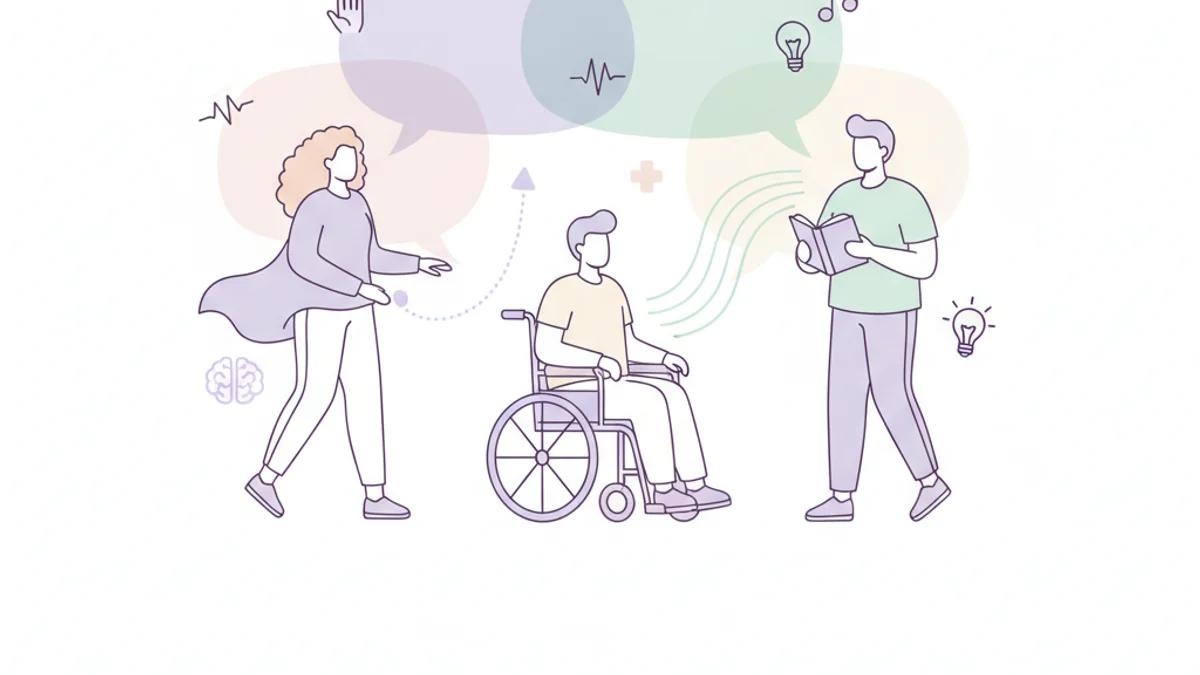
In a communication culture that values conciseness, autistic people often encounter misunderstandings when they choose to share a lot of information. What may be perceived by neurotypical eyes as "over-explaining" is actually a natural expression of a neurological profile that strives for clarity, precision, and the prevention of misunderstandings. This article will delve into the phenomenon of over-explaining in adult autistic communication, presenting it not as a social failure, but as a powerful strength whose primary goal is deep and authentic communication.
The neurodiversity paradigm teaches us that Autism is not a condition to be "fixed" or "cured," but a unique neurological characteristic that offers alternative ways of thinking and communicating. Instead of judging over-explaining as a lack of tact, we are invited to examine it as a legitimate attempt to build bridges of understanding in a social space that is not always adapted. This understanding is essential to reduce social anxiety and encourage more inclusive environments for autistic people.
What is "Over-explaining" in the Autistic Context?
The term "over-explaining" describes a situation where a person shares more information than is socially expected in a given situation. For many autistic people, this is an inherent communication style, driven by an internal urge to ensure that the message is fully understood, without ambiguity or misinterpretation. When a simple question is asked, the autistic response tends to be detailed and comprehensive, contrary to the expectation of a concise and general answer.
This difference often stems from different assumptions about the purpose of communication itself. While neurotypical communication may often serve as a tool for social bonding or maintaining harmony, autistic communication is often aimed at conveying information as accurately, efficiently, and completely as possible. This mismatch between communication goals is what creates the gap in perception between "clarity" and "over-explaining."
The Roots of Detailed Communication in Autistic People
The Need for Clarity and Precision
Autistic minds tend to process information in a particularly logical and precise manner. This is reflected in a strong need to understand things in depth and express them completely clearly, so that there is no room for doubt or misinterpretation. When an autistic person shares information, they may treat every small detail as vital to understanding the full picture, leading to extensive detail that may not be necessary for the neurotypical listener. The pursuit of precision is not a luxury, but an essential component of the perceptual and cognitive experience.
Many autistic people describe a situation where they prefer to say more rather than less, to ensure that all aspects of the message have been openly expressed. They may experience difficulty understanding non-verbal social cues, and therefore rely on words to convey their message accurately. This style, sometimes called "Literal Thinking," is a prominent characteristic that significantly affects their communication style and their perception of the world. It is an attempt to build a sure bridge of understanding.
Challenges of Social Uncertainty
The social world is full of uncertainty, and many autistic people experience significant anxiety as a result. To reduce anxiety levels and strengthen a sense of security and functioning, autistic minds develop various strategies, one of which is careful planning and scripting of social interactions. They may rehearse conversations in their heads many times before they occur, to reduce uncertainty about possible reactions and ensure their message is conveyed as desired. This is a complex process that requires significant cognitive effort.
When social uncertainty impairs the sense of security, providing detailed information becomes a vital defensive strategy. By providing broader context and comprehensive explanation, autistic people try to minimize the chances of misinterpretation or an unexpected reaction. This is not "drama" or meaningless "overthinking," but a coping mechanism that helps them navigate an unpredictable world. It is their way of creating a sense of control and safety in a complex and dynamic social environment.
Differences in Information Processing
Autistic people often experience differences in Executive Functioning, such as difficulty with task switching, working memory, and real-time planning. These difficulties can affect the ability to quickly filter information and adapt the amount of detail required according to the changing social context. Therefore, when an autistic person provides information, they may present all available data, without performing filtering that is perceived as natural for others. This process requires significant attentional resources.
The challenge in spontaneous communication is particularly significant. Where others respond intuitively, an autistic person may need additional processing time to formulate a detailed and accurate response. If these processing times are not allowed, a feeling of inability to communicate effectively may arise. A lack of understanding of these processing times can lead to autistic people being perceived as uninterested or slow, while in reality, they are simply operating in a different cognitive style.
Between Clarity and Social Expectations - The Challenges
The gap between the autistic need for clarity and social expectations for conciseness can lead to a variety of challenges. Social interactions can become cumbersome and exhausting, as sincere attempts to communicate comprehensively are mistakenly interpreted as a lack of tact, disinterest, or even rudeness. Many autistic people report being described throughout their lives as "weird," "cold," or "rude," simply because of their direct and detailed communication style. Such a label can be extremely painful and isolating.
The constant effort to "Masking" - an attempt to conform to neurotypical norms in communication - takes a heavy emotional and cognitive toll. Careful planning of conversations, constant self-monitoring of every word and reaction, and an attempt to understand subtle social cues, often lead to deep exhaustion. This exhaustion, sometimes called "Sensory Hangover" or "Autistic Burnout," affects the ability to function in all areas of life. The need to analyze every aspect of communication is an enormous burden.
When detailed communication is perceived as negative, autistic people may develop a fear of critical reactions, leading to avoidance of interactions or limiting information sharing. This persistent feeling of misunderstanding and mismatch can harm self-esteem and mental well-being. It is important to recognize that the difficulty lies not in "over-explaining" itself, but in the gap in expectations and interpretation between different communication styles. Mutual investment in flexibility and understanding is required.
The Power of Clarity: Advantages of Over-explaining
Despite the challenges, the detailed communication style of autistic people has distinct and powerful advantages that can enrich human interactions if we only learn to recognize them. One of the prominent features is the ability to completely prevent ambiguity. When information is conveyed accurately and comprehensively, the risk of misinterpretations, guesses, or misunderstandings is significantly reduced. In professional, academic, or technical contexts, such clarity is an invaluable asset, saving much time and resources.
Another advantage is building relationships based on authenticity and deep trust. When an autistic person shares information in detail, they are essentially inviting their interlocutor into an honest and open inner world. Friends and partners of autistic people often report that they appreciate the honesty and directness, and the absence of "social games" or double messages. These relationships, based on transparency, tend to be more stable and deep, allowing space for building genuine trust between the parties.
In addition, detailed communication contributes greatly to effective problem-solving and informed decision-making. When all relevant details are presented in an organized manner, it is easier to identify the root of the problem, examine alternatives, and formulate optimal solutions. This style encourages analytical and meticulous thinking, which is especially crucial in complex situations. It allows for examining every possible angle and basing decisions on full knowledge, rather than on assumptions or non-verbal cues. Many autistic people prove to be true experts in presenting data completely.
Strategies for Navigating Communication
Turning Over-explaining into an Advantage
Recognizing the value of detailed communication is the first step to turning "over-explaining" into an advantage. In many work environments, for example, accuracy and detail are highly sought-after qualities. Autistic people can find niches where their ability to present information comprehensively and leave no room for misunderstandings is appreciated. These include fields such as technical writing, research, data analysis, software development, or professions requiring meticulous attention to detail. Identifying and highlighting these strengths can lead to significant success.
One of the important tools is to preface with a brief explanation of the communication's intent. Instead of apologizing for detail, one can clearly state the need to clarify things. For example, one can say: "I want to make sure I understand well/I am explaining well, so I will elaborate a bit more, is that okay with you?". Such phrasing allows the interlocutor to know what to expect and gives them the option to express their preference. Openness and dialogue around communication styles are key to creating mutual understanding. This is a way to invite the other to accommodate the unique communication style.
Tools for Mutual Communication
Autistic people can use strategies such as preparing "scripts" in advance for anticipated conversations, especially in recurring social interactions. These scripts can include phrases for opening a conversation, transitions between topics, and even ways to end a conversation clearly, which many describe as a challenge. One can also offer opening sentences that invite the other to signal when details become superfluous. For example: "I will explain in detail, but feel free to stop me if you have enough information."
On the other hand, neurotypical people can adopt a proactive approach of active listening and patience. Instead of drawing conclusions from "over-explaining," it is advisable to ask clarifying questions and look for the intention behind the detail. One can also express appreciation for the clarity and accuracy. Using phrases like "I understand that it's important for you to explain this fully, and I appreciate it" can strengthen the autistic person's sense of security and allow them to feel understood. It is worth remembering that the effort to explain in detail is often an expression of concern and a deep desire to understand and be understood.
The space for creating improved mutual communication requires flexibility from both sides. Autistic people can learn to distinguish different contexts and practice more conscious filtering of information, while others can learn to appreciate the richness and precision inherent in autistic communication. Through open dialogue and mutual respect for different communication styles, bridges of understanding can be built and stronger, more inclusive relationships fostered. The goal is not to change who we are, but to expand the ways in which we connect with each other.
Over-explaining in autistic communication is not a flaw to be suppressed, but an expression of a unique neurological profile that strives for clarity, precision, and authenticity. It reflects a deep need to ensure that the message is fully understood, as a way to cope with social uncertainty and build trust-based relationships. When we shift our perspective and see it as a strength, we open the door to a deeper understanding of autistic people and their unique contribution to the world.
Fostering inclusive communication environments requires us to identify and recognize the value of all communication styles. Through patience, empathy, and the use of mutual communication strategies, we can turn "over-explaining" into a tool for building meaningful and stable relationships. This is an opportunity for all of us to learn how to connect better, while respecting neurological diversity and encouraging authentic self-expression.
Frequently Asked Questions
Why do autistic people tend to explain in great detail?
Autistic people are driven by a deep need for clarity and precision, and their goal is to ensure that the message is fully understood without ambiguity. This is a strategy to reduce social uncertainty and build trust, as opposed to the expectation of concise and general communication. The pursuit of precision is not a luxury but an essential component of the perceptual experience.
Is "over-explaining" always a negative thing in the autistic context?
No, what is perceived as "over-explaining" by others is actually an expression of the strength of clarity, precision, and authenticity. Although it can create social challenges due to expectation gaps, there are many advantages such as preventing misunderstandings, building deep trust, and efficiency in problem-solving, especially in professional or technical contexts. This style encourages analytical and meticulous thinking.
How can mutual understanding in communication be improved?
Neurotypical people can practice active listening, ask clarifying questions, and look for the intention behind the detail. Autistic people can preface their detailed explanations, thereby allowing the interlocutor to know what to expect. Open dialogue and mutual respect are key.
Is there a connection between anxiety and detailed communication in autistic people?
Absolutely. Many autistic people experience social uncertainty that can trigger anxiety. Providing detailed information serves as a strategy to reduce this anxiety, by minimizing the chances of misinterpretation or an unexpected reaction from others. This is a vital coping mechanism in an unpredictable world.
What are the advantages of a detailed communication style?
A detailed communication style prevents ambiguity, reduces errors, and ensures that the message is understood accurately. It contributes to building authentic relationships based on trust, and strengthens problem-solving and informed decision-making abilities. In many work environments, accuracy and detail are highly sought-after qualities.