Autodidactism (Self-learning) is the ability or practice of acquiring knowledge, education, skills, or deep understanding of a particular subject independently, without relying on formal educational frameworks (such as schools or universities) and without direct instruction from teachers or lecturers.
Autodidacts are often driven by deep internal motivation, intellectual curiosity, and a raw passion for discovery, and they navigate their learning path through independent exploration of books, articles, online courses, trial and error, and information gathering from the web.
The Clear Connection to Neurodiversity (Autism and ADHD)
Within the neurodivergent community, Autodidactism is not just a "hobby," but often a survival learning strategy and the preferred growth path. Many minds on the Autistic Spectrum or with ADHD struggle to survive or thrive within the formal education system, which is designed for the neurotypical majority.
The connection between unique neurological wiring and self-learning is expressed in several core axes:
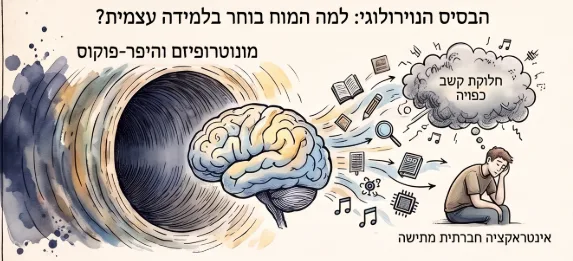
Special Interests and Monotropism: An autistic brain is wired for Monotropism - a narrow and deep attention tunnel. When a person locks onto a topic that interests them, they enter a monotropic flow and a state of extreme Hyperfocus. Self-learning allows them to dive deep into the data without external distractions, without the need for exhausting social "small talk," and without forced attention splitting.

Bottom-up thinking: Since autistic people process information by collecting countless small details until the full picture is built, conventional learning methods (which present the "big picture" top-down) lack logic for them. Self-learning allows them to explore the building blocks of the subject at the pace and in the unique logical order of their brain.
Bypassing Demand Avoidance and Burnout: The formal education system is saturated with constant external demands (tests, homework, grades, deadlines). For a brain with a PDA / Demand Avoidance profile, these demands trigger a survival anxiety response of "fight or flight." In self-learning, the "demand" is neutralized and becomes a "free choice," which prevents Autistic Burnout and allows learning out of security and curiosity.
The Autodidact's Spiky Skills Profile
As in many areas, here too there is a Spiky Skills Profile showing extreme gaps between strengths and difficulties:
The Peaks (Autodidact's Strengths) | The Valleys (Challenges in Self-Learning) |
|---|---|
Phenomenal Depth of Understanding: Ability to reach a professor's level of expertise and precision in focused topics, thanks to relentless perseverance and curiosity. | Executive Functioning Difficulties: Difficulty organizing material, time management, perseverance in tedious tasks (like bureaucracy or submitting assignments), and Analysis Paralysis in the face of abundant information. |
Thinking Outside the Box: Lack of institutional dictation allows for the development of creative solutions, original approaches, and pattern recognition that people who followed a regular path would miss. | Lack of Formal Certification: Society and employers still suffer from institutional Ableism and tend to value official degrees more than actual knowledge, making it difficult to find suitable employment. |
Full Personalization: The ability to learn in a quiet environment, without Sensory Overload, while using independent Reasonable Accommodations (such as free movement or Stimming while learning). | Difficulty Setting Boundaries: Tendency to immerse oneself in learning to the point of harming physical health (ignoring hunger, sleep, or pain signals due to difficulty with Interoception). |
The Path to Integration: From Frustrated to Autonomous
Often, neurodivergent autodidacts develop internalized Ableism and Impostor Syndrome, as their environment perceived their difficulty integrating into frameworks as laziness or inability.
The accepting approach based on the Social Model of Disability calls for recognizing Autodidactism as a legitimate and respectful learning path:
Accessible Opportunities: Employers and institutions should value practical skills and knowledge (portfolios, performance tests) rather than just official certificates.
Targeted Assistance: Providing external support (such as in Supported Employment programs) focused only on the person's points of difficulty (organization, self-marketing, communication mediation) without interfering with the learning content itself or engaging in Infantilization.
Unmasking: Giving full legitimacy to the person to explore their world in their own way, without guilt for not fitting the traditional learning mold.