Autistic Inertia is a term describing a deep and inherent neurological difficulty in starting a new task, or conversely - stopping an existing task and moving on to the next thing. The concept is drawn from the world of physics (Newton's law of inertia), according to which a body at rest tends to remain at rest, and a body in motion tends to remain in motion unless an external force acts upon it.
In everyday reality, Autistic Inertia works exactly like this, and it manifests in two extreme directions:
Difficulty starting (body at rest): A state where the person knows exactly what they need to do (for example: get out of bed, shower, start writing a paper), strongly wants to do it, but experiences a physiological "disconnect" between the desire and the motor action. They feel completely paralyzed in their chair or bed, an experience associated with Analysis Paralysis and an overload on the nervous system.
Difficulty stopping (body in motion): Once the person has managed to get themselves moving and entered a certain activity, their brain locks onto it with maximum intensity (a state of Hyperfocus stemming from Monotropism). At this stage, any external demand to stop, "switch gears," or move to another task requires enormous and painful cognitive effort, and can trigger intense anxiety or frustration.
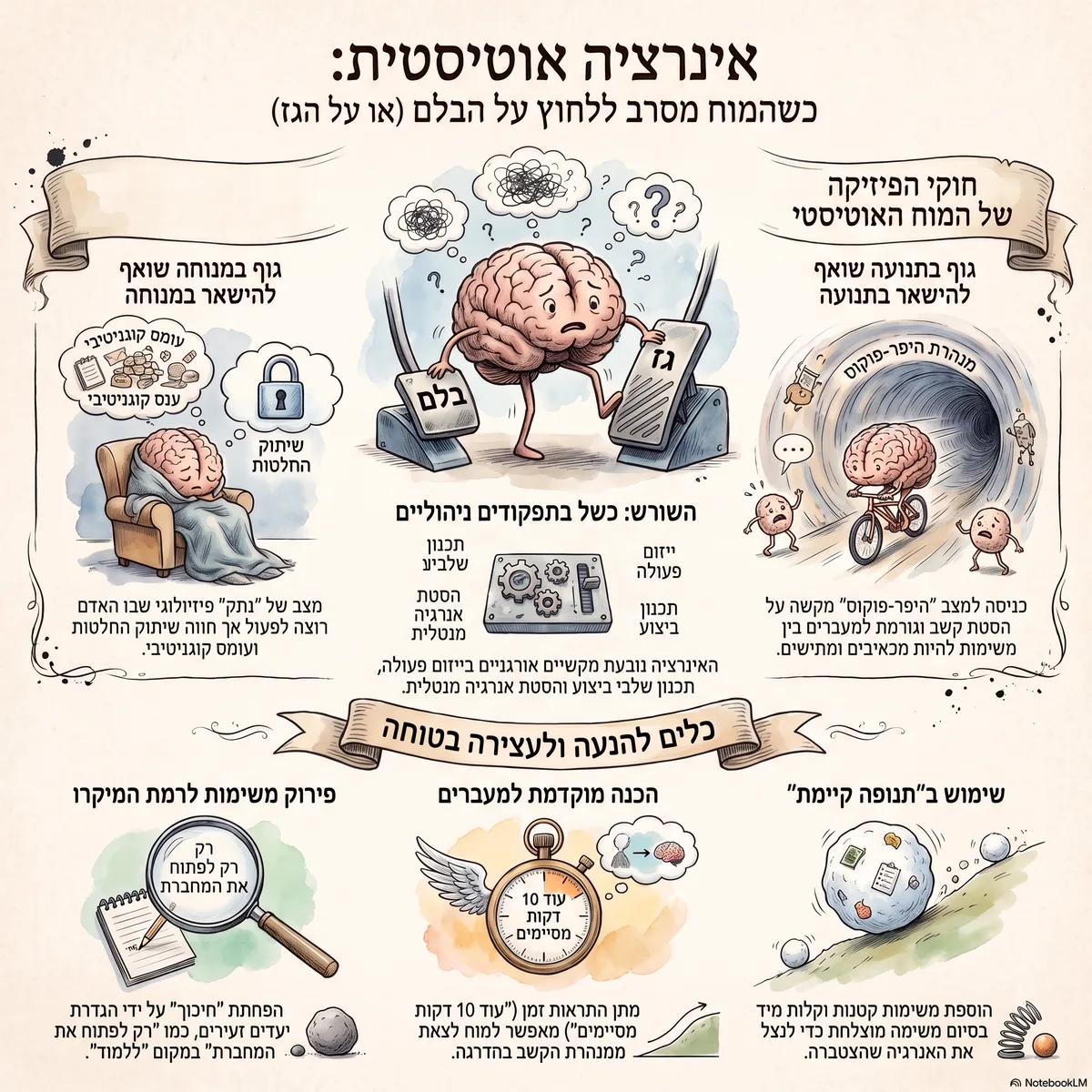
The Neurological Origin: Executive Functioning Failure
The neurotypical environment tends to mistakenly interpret Autistic Inertia as laziness, lack of motivation, or stubbornness (which often leads to phenomena of Infantilization and judgmentalism). In practice, it is an organic and severe challenge in the brain's Executive Functioning, especially in three stages:
Initiating action: The brain's ability to send the neurological signal that tells the body "go."
Planning and execution stages: Tasks that seem simple to others (like "washing dishes") are perceived by the autistic brain as a complex and overwhelming sequence of dozens of sub-tasks, which creates a cognitive load that blocks movement.
Shifting attention: The ability to disconnect mental energy from one attention tunnel and transfer it to another.
The Energetic Cost and Exhausting Masking
Autistic Inertia burns an enormous amount of "spoons" (according to Spoon Theory). The internal effort to fight paralysis and forcefully move the body, or the attempt to perform Masking and appear flexible and available to environmental demands, depletes the person's resources.
When a person is repeatedly forced to interrupt tasks they are engaged in, or when they are pushed beyond their capabilities, their nervous system quickly reaches a state of Sensory Overload, leading directly to a Sensory Hangover, Meltdowns or Shutdowns, and in the long term - to chronic Autistic Burnout.
Support Strategies and Reasonable Accommodations
Healthy coping with inertia is not based on rigid "self-discipline," but on creating an accessible environment and physiological understanding:
Using "existing momentum": Adding small, easy tasks immediately after a successful task, to utilize the energy the brain is already in.
Reducing friction in the initial stages: Breaking down large tasks into tiny micro-parts (for example: instead of "studying for the exam," the task is just "open the notebook on the table").
Preparing in advance for transitions: Providing early warnings and ample time before a change is required ("in 15 minutes we're leaving," "in 5 minutes turn off the computer"), allowing the monotropic brain to gradually and safely exit the attention tunnel.
Unmasking and self-compassion: Accepting that the neurological pace is different, and legitimizing long rest periods without guilt or internalized Ableism.